

After 35 years in aerospace, here's why the most powerful answer to AI's energy demand is the land we already have.
By Bill Flood, Head of Engineering, Exowatt
–
The headlines have been hard to miss. A Seattle-area startup building solar-powered data centers in space just became the fastest company in Y Combinator history to reach a $1.1 billion valuation. SpaceX has filed with the FCC for a constellation that could eventually reach a million data-center satellites, and is reportedly in talks with Google to put compute in orbit. NVIDIA used its spring GTC keynote to announce a space-rated GPU platform. China has flown an orbital compute constellation and run a large language model on it. And if space feels too far, there's a parallel rush to drop data centers into the ocean. A Peter Thiel-led round just put $140 million into wave-powered floating compute, and a 24-megawatt undersea facility off Shanghai is already running on offshore wind.
It's a genuinely exciting moment for hard engineering. But most of these efforts are really trying to solve one problem: finding enough clean, affordable power to run AI. And on that, I think we're at risk of overlooking the most abundant resource we already have, sitting right here on the ground.
I spent the better part of my career in the space and defense industry, most recently leading space vehicles at Moog, and before that in advanced-technology roles across aerospace. I have deep respect for the people doing this work, and for how hard these problems are. So I want to be clear up front: what follows isn't a critique of their engineering. It's a case that we may not need to take that path at all, because the sun and the land we'd need are already here — in abundance.
The one truism of the space business
If there's a single thing the space industry taught me, it's this: the applications that truly belong in space are the ones that genuinely cannot be accomplished on Earth.
GPS belongs in orbit. Earth observation belongs in orbit. Communications relay belongs in orbit. These are missions where the vantage point is the product. You cannot do them from the ground at any price.
Powering and housing bulk AI compute is a different kind of problem. There's nothing about training or serving a model that requires the vacuum of space or the bottom of the sea. The appeal is real: abundant solar energy and natural cooling. But both of those are available on Earth too, in places we already control.
Hard problems we may not need to solve
Putting compute in orbit, or under the ocean, means signing up for a long list of genuinely hard engineering problems: electronics that can survive a launch and keep running in a punishing environment, systems that have to be built and serviced where people can't easily reach them, and the considerable cost of getting there and staying there. The ocean brings its own version of this. Seawater is corrosive and access is limited, even if the natural cooling is what makes it appealing. Talented teams are taking all of it on, and some of it will surely get solved.
But the more useful question isn't whether these problems can be solved. It's whether we need to solve them at all. Every one of them is a cost of leaving Earth, and not one of them exists if the power and the compute simply stay on the ground.
The constraint that doesn't show up in the pitch deck
Here's something the orbital and undersea pitches tend to skip past: a lot of what's slowing AI infrastructure right now isn't engineering at all. It's permission.
Across the country, communities are increasingly pushing back on large data centers through local rejections, moratoriums, and withdrawn projects, and not only in the places you'd expect. Read the objections and a pattern jumps right out. Water use. Strain on the local grid and electricity rates for everyone else. Noise. Traffic. Property values. The view. Nearly every one of these is a proximity problem. It exists because the facility is being built next to where people live.
Which points to a simple idea that the space-and-ocean conversation overshot in the other direction: you don't have to leave the planet to get away from the neighbors. You can put the load where there are no neighbors.
Remote Southwest land addresses this structurally, rather than through years of hearings, concessions, and negotiation. Site a facility on open desert, well away from any town, and most of that catalog of proximity concerns simply doesn't arise: there's no view to spoil, no neighborhood to keep awake, no commute to clog. And when the power is generated on-site from the sun rather than drawn off the regional grid, the most sensitive concern of all, the worry that a project will raise local electricity bills or strain a community's power, comes off the table.
Water deserves its own mention, because it's the one concern that following the sun to the desert doesn't solve on its own. The desert is, after all, dry. But our way of making power barely touches it: storing solar heat and running it through a heat engine uses only a small fraction of the water a conventional steam-cycle plant consumes. So even in a dry region, we're not adding a thirsty new draw on a scarce resource. In the end, you're not competing with anyone for grid capacity, water, or quiet. You're operating where that conflict doesn't exist.
That's not a small thing. Increasingly it's the difference between a project that gets built and one that doesn't.
The answer is already under our feet
So the two things genuinely constraining AI buildout on Earth aren't cooling or a shortage of places to put a server. They are dispatchable power, delivered quickly, where the load is, and the community's permission to build at all. The American Southwest answers both at once.
The United States has an enormous, underused advantage on exactly that front: solar-friendly land. The Southwest, including Arizona, Nevada, New Mexico, West Texas, Utah, Colorado, and inland California, has some of the best direct sunlight on the planet, sitting next to land that is flat, open, and abundant. You don't need to escape the atmosphere to find plentiful sun. You just need to point at the desert.
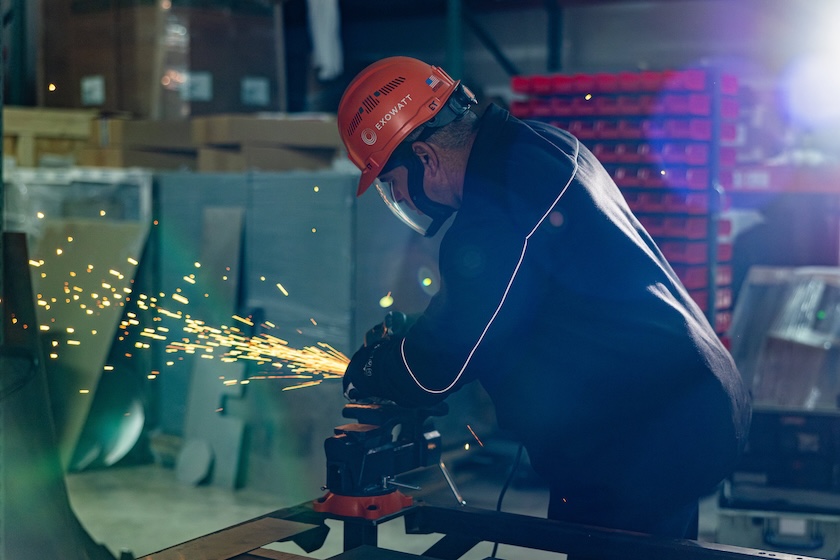
That's the premise Exowatt is built on. Our P3 is a modular, scalable system that captures solar energy as high-temperature heat, stores it in a long-duration thermal battery, and converts it to electricity on demand through a heat engine, delivering up to 24 hours of dispatchable power a day, packaged to fit a standard shipping container footprint. It deploys quickly, with or without a grid interconnection, so a data center can come online without waiting years for a utility upgrade.
Compare the two paths. One asks you to engineer hardware for launch and space, build the systems to deliver it to orbit and keep it running, and bear the cost of doing all of that off the planet. The other asks you to build a container out of common materials like steel and silica sand, set it on open desert well away from anyone who'd object, power it on-site from the sun with a modular system that already exists, and run it, with no launch, no hostile environment, and no zoning fight.
I find that comparison clarifying. We don't need space. We don't need the ocean. Reserve those environments for the things that truly can only be done there. For powering AI, we should deploy what works, on the land we already have — and that land happens to be some of the sunniest real estate in the world.